

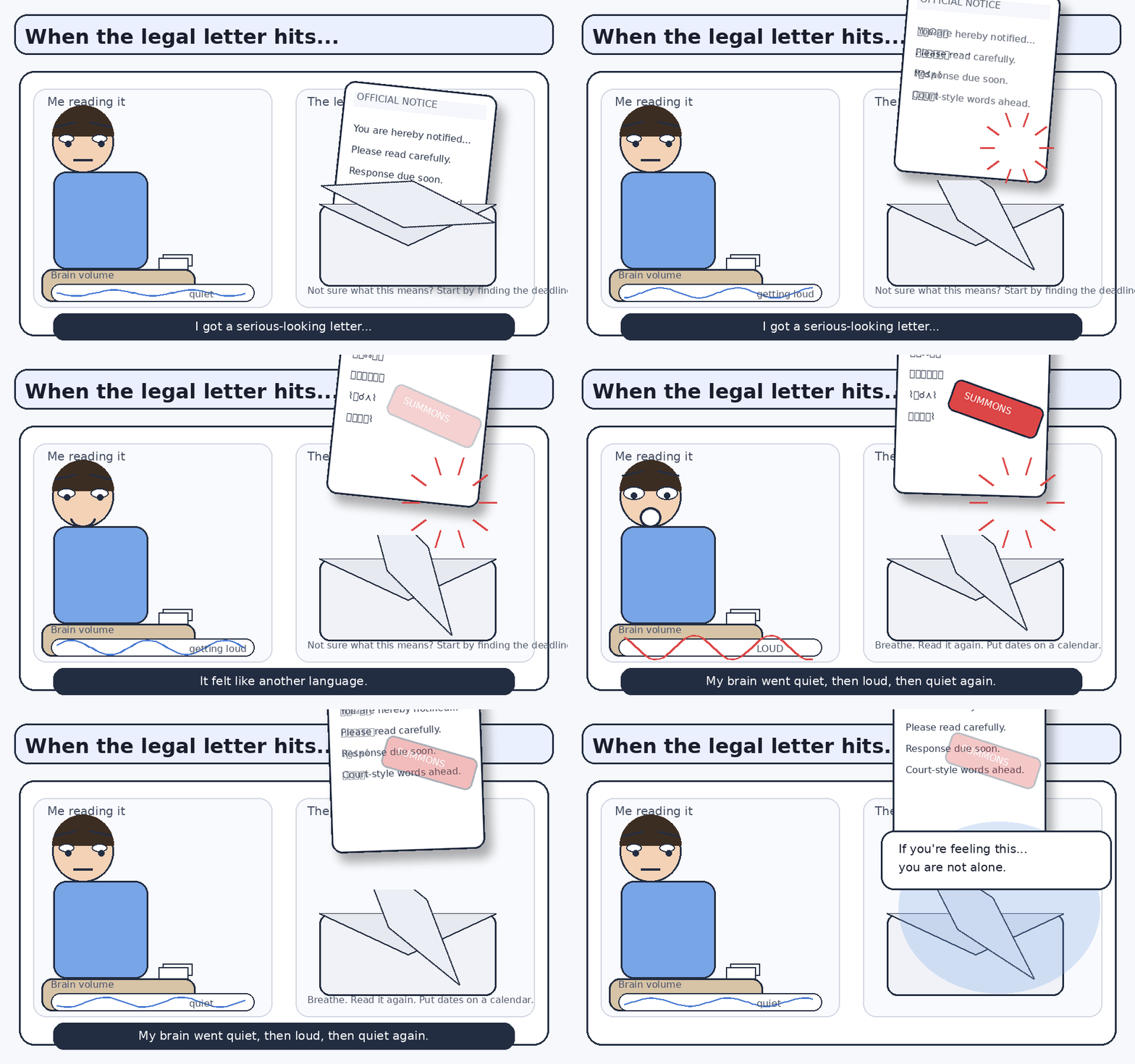
The first time I got a serious-looking letter with court-style words, I stared at it like it was written in another language. My brain went quiet, then loud, then quiet again. If you are feeling that right now, you are not alone.
Legal advice basics is the simple know-how that helps you understand what your legal papers mean, what steps usually happen next, and how to choose a safe next move without guessing. It does not promise results, and it does not replace a licensed lawyer for your exact case.
This guide is legal information for learning. It is not legal advice, and it does not create a lawyer-client relationship. Also, laws and deadlines can change by state, so you always confirm the rules where you live.
What legal advice basics really means (and what it does not mean)
Legal advice basics means learning the common building blocks of legal problems so you do not miss deadlines, lose key papers, or follow bad internet tips. For example, it includes understanding what a summons is, what a notice usually asks you to do, and what “file” and “serve” often mean in plain terms.
At the same time, legal advice basics does not mean you can copy someone else’s plan and expect it to work for you. The details matter, like dates, location, and what documents you received. Because of that, any guide like this can only explain the usual process and safe habits.
Here is how I keep the line clear in my own head. Legal information explains the system in general. Legal advice applies the law to your exact facts and tells you what you should do. That difference matters because only a licensed attorney can give legal advice for your situation.
So, what is the point of legal advice basics if it cannot tell you the perfect move?
It helps you avoid the two biggest mistakes I see people make. First, they wait too long because they feel confused. Second, they act too fast and send the wrong thing, to the wrong place, in the wrong way. As a result, they create more stress than they started with.
I use legal advice basics like a checklist. It helps me do three things in the right order.
First, I identify what the paper is and what the deadline says. Next, I collect proof and keep it together. Then, I choose the right place to start, like a court, a government agency, or a legal aid group.
Also, one small joke that is still true: the law loves paperwork the way cats love knocking things off tables. It is not personal. It is just how it is.
Finally, if your problem involves safety, housing loss, criminal accusations, or a court deadline you cannot meet, then legal advice basics is not enough by itself. In those cases, contacting a licensed lawyer or a legal aid office quickly is the safer step.
Legal information vs legal advice: the line that protects you
Legal information explains the law and the process in general terms, while legal advice tells you what to do based on your exact facts. Once you see that difference, a lot of legal confusion clears up.
Legal information can include court forms, step-by-step filing guides, and plain explanations of common words. It can also include government pages that explain how to report certain issues. For example, if you have an unpaid wage problem, the U.S. Department of Labor explains how to file a complaint with the Wage and Hour Division. (DOL)
Legal advice is different because it answers questions like, “Should I file this now or wait?” or “Which argument should I use?” That is personal strategy tied to your facts.
This matters because people often search for legal advice basics when they want certainty. However, no honest source can promise an outcome. Results change based on evidence, deadlines, and local rules.
Here is the quick test I use when I read a page:
- If it says, “Here is what this means” or “Here is the usual process,” it is probably legal information.
- If it says, “Do this exact thing to win” or “This will guarantee your result,” I treat it as unsafe and I leave.
Also, court staff and many self-help centers can share legal information and explain procedure, yet they cannot choose a plan for your case. That is part of how courts stay neutral.
This is also where scams sneak in. A scam page often sounds very certain and very urgent. It pushes you to pay right now. It might also pretend one rule fits all 50 states.
Instead, a safer page usually does these things:
- It names the agency, court, or program clearly.
- It points you to official forms or official reporting steps.
- It warns you that time limits can change by state.
- It avoids promises.
If you are in the U.S., government sources are a strong starting point for legal information. For example, USA.gov has a legal aid page that points people to low-cost and free help options. (USAGov)
So, legal advice basics is not just about learning words. It is about learning how to tell safe information from risky guidance. That skill alone can save you money and stress.
Court or agency: how I pick the right starting point in the U.S.
A lot of legal problems do not start in court, so legal advice basics includes knowing when a government agency is the right first stop. When I learned this, I stopped wasting time.
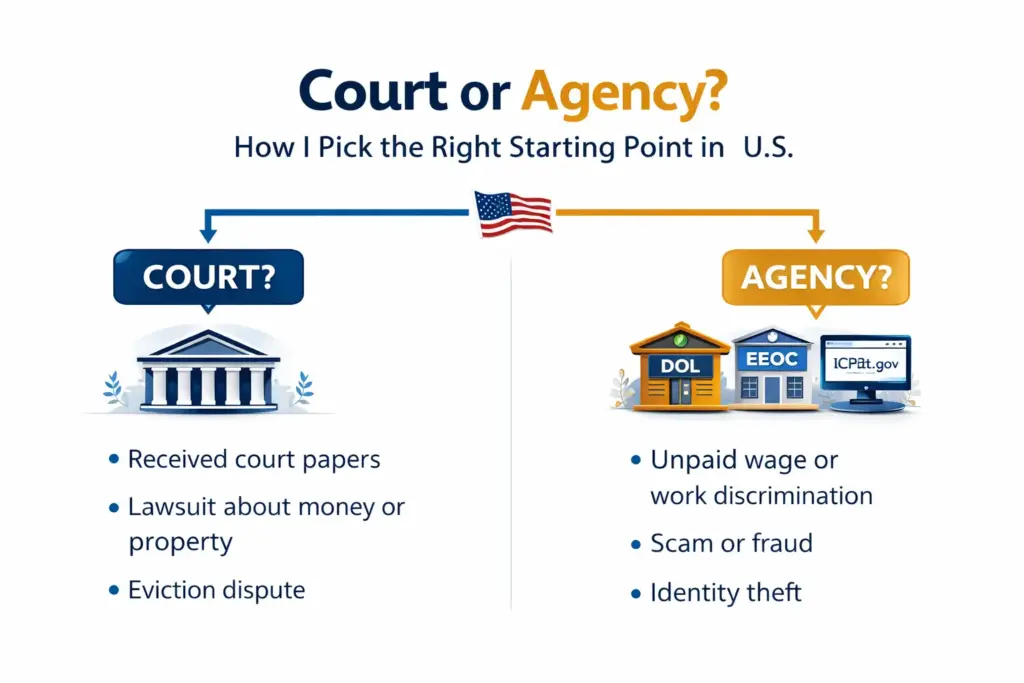
I use a simple three-step thought process.
First, I name the topic: work, housing, debt, family, identity theft, immigration, or a court case. Next, I ask, “Is there an agency that handles this first?” Then, I check the time limit rules.
Here are common U.S. examples that show why this matters.
Unpaid wages and overtime
If the issue is wages, the Wage and Hour Division at the U.S. Department of Labor is a common starting point. The Department of Labor explains how to file a complaint and how to contact help. (DOL)
If I am dealing with this topic, I gather the basics first: employer name, dates, pay rate, hours worked, and any pay stubs or messages. Then, I check the official complaint steps.
Job discrimination
For job discrimination, the Equal Employment Opportunity Commission explains how filing works, including using the EEOC Public Portal process. (eeoc.gov)
This is a strong example of why timing matters. Many discrimination claims have deadlines, and those deadlines can vary by the kind of claim and location. So, I do not rely on random posts for time limits. I go to the official filing page first.
Debt collection and validation notices
If you get a debt collection notice, the Consumer Financial Protection Bureau has clear explanations of what information a collector must provide and what options you have, including disputing the debt in writing within a set period. (Consumer Financial Protection Bureau)
The CFPB also publishes the federal rule text on validation notice requirements, which can help you understand what should be included. (Consumer Financial Protection Bureau)
Scams and identity theft
If your issue is identity theft, the federal government’s main recovery resource is IdentityTheft.gov, which gives step-by-step actions. (IdentityTheft.gov)
If you were scammed or want to report fraud, the FTC reporting site is ReportFraud.ftc.gov. (ReportFraud.ftc.gov)
Immigration scams and authorized help
If the issue touches immigration, USCIS has a page that helps people find authorized legal services and avoid scams. (USCIS)
Now, when does court come first?
If you received court papers, like a summons or a complaint, you treat it as urgent. You track the deadline and identify the court. Even then, legal advice basics is still useful because it helps you stay organized and ask better questions fast.
The 30-minute plan I use to stop the panic and take control
Legal advice basics starts with control, and control starts with a simple routine that turns fear into a checklist. When I feel stress rising, I do not begin by searching ten sites. Instead, I do this.
Step 1: I write a one-page timeline
I write dates and facts only. I keep it short. If I do not know a date, I write “unknown” and move on. That way, I do not invent details by accident.
Then, I add the one sentence goal. For example: “I need my wages paid” or “I need to respond to this court paper on time.” This keeps me from chasing side issues.
Step 2: I build one folder and one naming rule
I create one folder called “Legal” and subfolders like “Letters,” “Court,” “Receipts,” and “Screenshots.” After that, I name each file like: 2026-02-18 Notice from landlord. This keeps things easy to find.
Also, here is my honest joke: I do not name anything “final” anymore, because nothing is final. It is always “final v7” and I do not want to lie to myself.
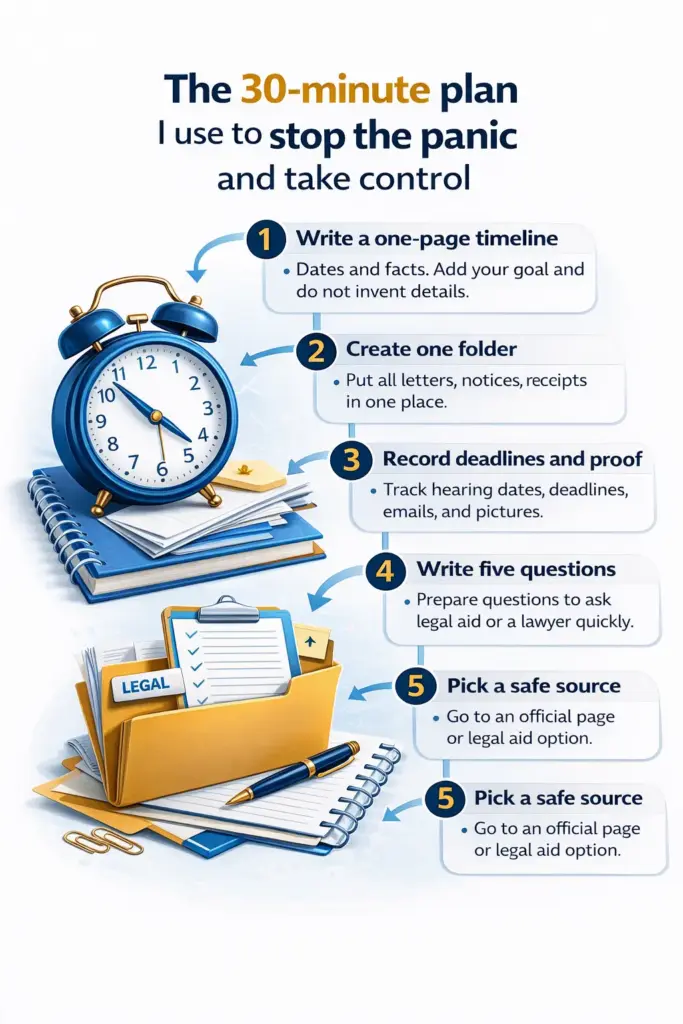
Step 3: I list deadlines and proof in plain bullets
I make a short list:
- Deadlines and hearing dates
- People and offices involved
- Key documents I have
- Key documents I do not have yet
Then, I set two reminders for each deadline. One reminder is early. One reminder is very early.
Step 4: I write five questions before I talk to anyone
This step saves me. When I am stressed, I forget what to ask. So, I write questions like:
- What is the deadline and what counts as “filed”?
- What proof is most important for this type of issue?
- Where do I submit forms and how do I keep a copy?
- Is there a free or low-cost help option for this problem?
- What are the next steps if the other side does not respond?
Step 5: I choose a safe source for the next action
This is where legal advice basics becomes real. If it is wages, I use the official DOL complaint steps. (DOL) If it is discrimination, I start with the EEOC filing process page. (eeoc.gov) If it is identity theft, I start with IdentityTheft.gov. (IdentityTheft.gov)
This plan is simple on purpose. It works because it reduces guessing. It also helps you talk to legal aid or a lawyer in a clear way, since you have dates, proof, and a goal ready.
Where I send people for real help (and how I avoid fake legal services)
Legal advice basics includes knowing where to look for help that is real, licensed, and accountable. In the U.S., that usually means legal aid directories, court self-help centers, and official government guidance.
Free and low-cost help
If someone tells me they cannot afford a lawyer, I start with USA.gov’s legal aid page, because it points people to recognized help options. (USAGov)
From there, many people use the Legal Services Corporation locator to find an LSC-funded legal aid program near them. (lsc.gov)
LawHelp.org is also commonly listed as a place to find legal aid info by state and topic, and it is referenced through USA.gov. (USAGov)
If your case is in state court, many states have self-help pages for people representing themselves. As one example, Michigan Courts has a self-represented litigants resource page, and many other states offer similar tools. (Michigan Courts)
Lawyer referrals and limited-scope help
Another option is a lawyer referral service through your state or local bar association. The American Bar Association also has public guidance on finding legal help. (americanbar.org)
Some lawyers offer limited-scope services, meaning they help with part of a case rather than everything. This can lower cost, and it can still reduce risk.
How I avoid fake legal services
This part is not optional. Scams often target people who are scared and in a hurry.
Here are my simple rules:
- I verify that the person is allowed to do legal work in my state.
- I ask for the scope and fee in writing.
- I walk away from anyone who promises a guaranteed result.
If the issue touches immigration, I use USCIS guidance to find authorized legal services and avoid scams. (USCIS)
If I got scammed, or even if I spotted one, I report it using the FTC process, including ReportFraud.ftc.gov. (ReportFraud.ftc.gov)
Also, one quick reality check that makes me laugh and also saves me: real offices do not ask you to pay in gift cards. If someone says “go buy gift cards,” the answer is no.
Finally, if you plan to use online tools to draft anything for court, be careful. You are responsible for what you file. So, legal advice basics includes checking everything against official sources before you submit it.
FAQ: Legal Advice Basics (what people usually ask)
1) Is legal advice basics the same as hiring a lawyer?
No, legal advice basics is general learning, while a lawyer gives advice based on your facts and local law.
2) Where can I find free or low-cost legal help in the U.S.?
Start with USA.gov legal aid, then look for Legal Services Corporation funded programs and local legal aid options. (USAGov)
3) What should I do first when I get a court letter?
First, read for the deadline and court name, then save copies, then get help fast if the deadline is soon.
4) How do I file an unpaid wage complaint?
Use the U.S. Department of Labor Wage and Hour Division complaint steps and contact options listed on their site. (DOL)
5) How do I file an employment discrimination charge?
Use the EEOC process, which starts with an online inquiry and then a formal charge through the EEOC system. (eeoc.gov)
6) What should a debt collector tell me about a debt?
The CFPB explains required debt validation information and your dispute options, including time limits. (Consumer Financial Protection Bureau)
7) Where do I report identity theft?
Use IdentityTheft.gov for step-by-step recovery and reporting. (IdentityTheft.gov)
8) Where do I report scams and fraud?
Use ReportFraud.ftc.gov, the federal reporting site for fraud and scams. (ReportFraud.ftc.gov)
Official U.S. links you can use in the article
USA.gov legal aid: https://www.usa.gov/legal-aid
U.S. Department of Labor - WHD complaint steps: https://www.dol.gov/agencies/whd/contact/complaints
EEOC - file a charge: https://www.eeoc.gov/filing-charge-discrimination
CFPB - debt collection help: https://www.consumerfinance.gov/consumer-tools/debt-collection/
CFPB - debt validation info (consumer page): https://www.consumerfinance.gov/ask-cfpb/what-information-does-a-debt-collector-have-to-give-me-about-the-debt-en-331/
FTC - report fraud: https://reportfraud.ftc.gov/
FTC - report identity theft topic page: https://www.ftc.gov/news-events/topics/identity-theft/report-identity-theft
IdentityTheft.gov steps: https://www.identitytheft.gov/steps
USCIS - find authorized legal services: https://www.uscis.gov/scams-fraud-and-misconduct/avoid-scams/find-legal-services