
Basic Legal Terms (Simple Guide for Real Life)
The first time I read a court letter, I stared at it like it was written in another planet’s language. The words were English, yet my brain still said, “Nope.” If that has happened to you, you are not alone.
Basic legal terms are common words used in law that explain who is involved, what papers are filed, what a court can decide, and what happens next in a case. Once you learn the meaning of these basic legal terms, letters, forms, and court talk start to make more sense.
What are basic legal terms?
Basic legal terms are the building-block words that explain the legal system in plain language. I notice most confusion happens when a paper uses a short word that has a strict meaning, like “jurisdiction” or “service.” So, learning these basic legal terms is like getting a simple map for a place you might need to visit when you least expect it.
First, these words show you who is involved. For example, in a civil case, the person who starts the case is usually called the plaintiff, and the person being sued is the defendant. Cornell Law explains that a plaintiff starts a lawsuit by filing a complaint against the defendant. (Legal Information Institute)
Next, these words show you what the paper is doing. A “complaint” is not just a complaint like “I am upset.” In court, a civil complaint is a written statement that starts a case and asks the court for a fix, called “relief.” The US Courts glossary explains this idea in a clear way. (United States Courts)
Also, these words show you what the court needs to hear. In federal civil cases, Rule 8 says a complaint should have a short and plain statement of why the court has power over the case, what the claim is, and what relief is requested. (Legal Information Institute) When I first read that, I laughed a little, because legal papers do not always feel short or plain.
Finally, learning basic legal terms helps you avoid mistakes. A missed deadline or a misunderstood paper can cause real harm. So, even if you never plan to step into a courtroom, knowing these words can still protect you.
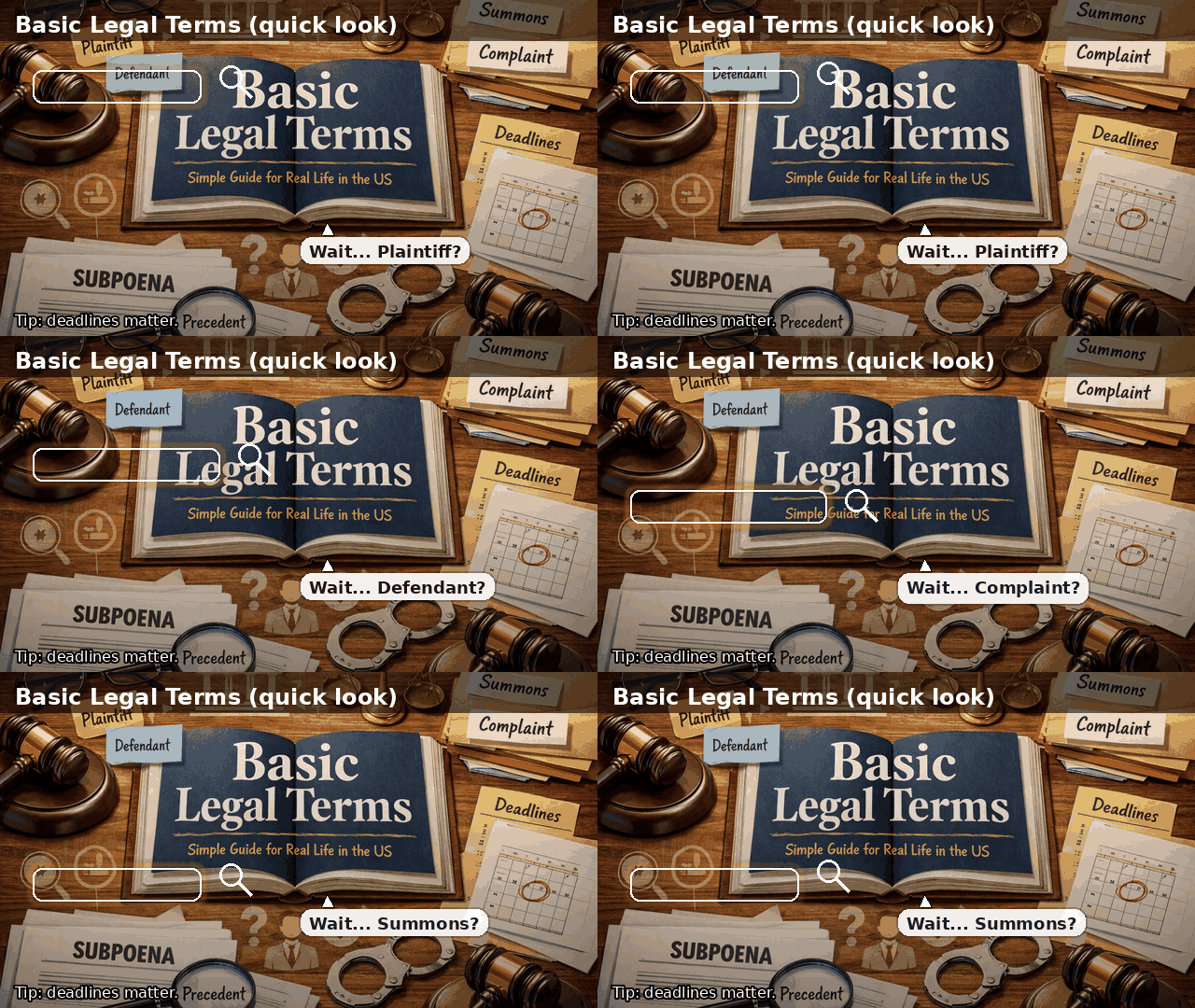
Who is who in a case?
The key roles in a case are the people who bring claims, respond to them, and decide the outcome. Once you know who is who, many basic legal terms stop feeling random and start feeling like labels on a diagram.
Plaintiff and defendant
A plaintiff starts a civil case, and a defendant is the person or group the plaintiff sues. Cornell Law explains that the plaintiff begins a lawsuit by filing a complaint and asking for a remedy like money damages or an order to stop something. (Legal Information Institute) That word “remedy” matters, because it tells you what the person wants the court to do.
In real life, I see people mix up these roles because they think “defendant” means “bad person.” However, in civil court, a defendant might just be someone accused of breaking a contract, like not paying a bill on time. So, in many disputes, these terms point to position in the case, not a moral label.
Also, the word “party” shows up a lot. A “party” means a person or group in the case, like the plaintiff, the defendant, or both. If you ever read “the parties agree,” it usually means the two sides agree, not that anyone is celebrating.
Here are real-life examples of plaintiff vs defendant:
Example 1: Unpaid rent (landlord-tenant)
- Plaintiff: The landlord (they start the case to recover rent or evict).
- Defendant: The tenant (the landlord says the tenant did not pay).
- Remedy: Money for back rent, late fees, and/or a court order for eviction.
Example 2: Car accident (injury claim)
- Plaintiff: The driver or passenger who got hurt (they sue for injuries).
- Defendant: The driver they say caused the crash (or sometimes the vehicle owner).
- Remedy: Money for medical bills, lost wages, and pain-related costs.
Example 3: Broken contract (freelancer and client)
- Plaintiff: The freelancer (they sue because the client did not pay).
- Defendant: The client or the client’s business.
- Remedy: Payment owed, sometimes plus interest and court costs.
Example 4: Consumer problem (refund dispute)
- Plaintiff: The customer (they sue because a store refused a promised refund).
- Defendant: The store or company.
- Remedy: Refund amount, possible extra costs depending on the claim and state rules.
Example 5: Property damage (neighbor dispute)
- Plaintiff: The homeowner (they claim the neighbor caused damage, like a fallen tree due to neglect).
- Defendant: The neighbor (or their insurer in some cases).
- Remedy: Money for repairs and cleanup.
Example 6: “Defendant does not mean bad person”
- A person can be the defendant simply because someone filed first.
- Example: A business gets sued over a billing dispute. The business may be right, but it is still the defendant because it is responding.
Example 7: What “party” means in real life
- If a court paper says “the parties agree”, it usually means:
- The plaintiff and defendant both accepted something (like a settlement date, payment plan, or schedule).
- It does not mean anyone is happy. It just means both sides said “ok” to a legal step.
Judge, jury, and clerk
A judge runs the court process and makes legal decisions, while a jury decides facts in many trials. Not every case has a jury, so do not assume you will see one. In some cases, a judge decides both the facts and the law.
A court clerk is also important. Clerks often handle filing and basic case steps. When I filed a simple form once, the clerk did not give legal advice, yet they did tell me where the line starts and where the stamp goes, which was still helpful.
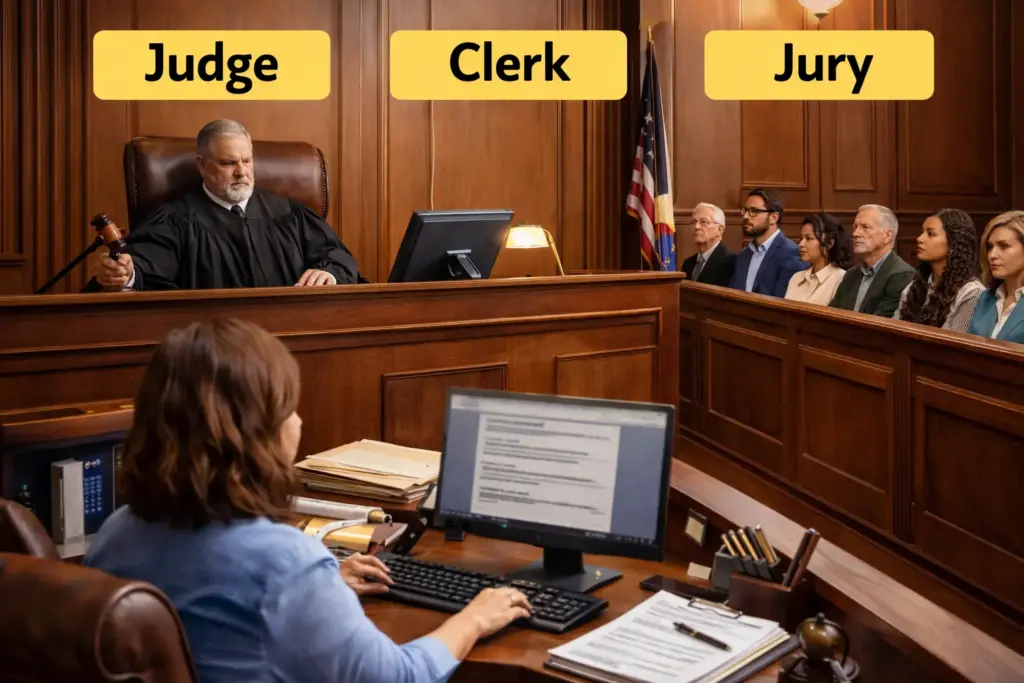
Judge, jury, and clerk (who does what)
Example 1: Judge in a hearing
- In a landlord-tenant case, the judge decides whether eviction rules were followed.
- The judge also sets deadlines and decides what evidence is allowed.
Example 2: Jury in a trial
- In a car crash trial, the jury decides whose story is more believable and what damages to award.
- The judge still controls the rules and gives the jury the legal instructions.
Example 3: Clerk at filing
- A person files an “Answer” at the clerk’s window.
- The clerk stamps it, enters it into the case file, and returns a copy.
Prosecutor and defense (criminal cases)
A prosecutor represents the government in a criminal case, and the defense represents the person charged. In a criminal case, the government claims a law was broken. So, the “plaintiff” word is not the usual label in a standard criminal prosecution.
This is where basic legal terms can save you from panic. If a paper says “the State” or “the United States” is the charging side, that does not mean a whole country is angry at you as a person. It means the government is the party bringing the case.
Prosecutor and defense (criminal cases)
Example 1: Shoplifting charge
- The prosecutor represents the state and tries to prove the charge.
- The defense challenges the evidence and argues for dismissal, a reduced charge, or trial.
Example 2: DUI case
- Prosecutor uses body cam, breath test results, and officer testimony.
- Defense questions the stop, the test accuracy, and whether rights were followed.
What papers start a case, and what do they mean?
The main papers that start many cases are the complaint, the summons, and proof that the other side received notice. These basic legal terms show up early, and they matter because they trigger deadlines.
Complaint
A complaint is the paper that starts a case and tells the court what happened and what the plaintiff wants. The US Courts glossary explains that a civil complaint is a written statement filed by a plaintiff that explains the court’s power to hear the dispute, the wrongs claimed, and the requested relief. (United States Courts)
In federal civil cases, Rule 8 sets the basic structure. It calls for a short and plain statement about jurisdiction, the claim, and the relief demanded. (Legal Information Institute) So, when you read a complaint, look for three things: why this court, what happened, and what the person wants.
Also, the word “alleged” appears often. It usually means “claimed but not proven yet.” That one word changes the meaning of a whole sentence.
Complaint (real-life examples)
A complaint is the paper that starts a civil case and explains what happened and what the plaintiff wants.
Example 1: Unpaid rent
- Landlord files a complaint saying: “Tenant owes $2,400 for 2 months rent.”
- It asks for a remedy: money owed and/or eviction.
Example 2: Car accident injury
- Injured person files a complaint saying: “The other driver ran a red light and caused my injuries.”
- It asks for a remedy: medical costs, lost wages, and other damages.
Example 3: Credit card debt lawsuit
- A debt buyer or lender files a complaint saying: “You owe $3,150 on this account.”
- It asks for a remedy: the amount owed plus interest and court costs.
Summons
A summons is a court-issued notice that tells a defendant they have been sued and must respond. One US district court describes a summons as a form that informs the defendant that they have been sued. (almd.uscourts.gov) When I explain this to friends, I say it is the paper that makes the case “real” for the person receiving it.
A summons often comes with instructions and a deadline. If you ignore it, you can lose by default in some situations. So, even if you disagree with the case, you still must read the deadline.
Summons (real-life examples)
A summons is the official notice that tells the defendant they have been sued and must respond by a deadline.
It usually comes with the complaint.
Example 1: Debt case
- You get an envelope with “Summons” and “Complaint.”
- The summons tells you: “You must file an Answer within X days” (the number depends on the court and state).
Example 2: Landlord-tenant eviction
- The summons may include a court date very soon.
- It tells the tenant when to show up or how to respond.
Example 3: Car accident lawsuit
- The summons tells the defendant they must respond through the court process.
- It often includes court name, address, case number, and response deadline.
Example 4: Business lawsuit
- The summons may be delivered to a company’s registered agent.
- It tells the business: respond properly or risk a default judgment.
Service of process and proof of service
Service of process is the method used to give the defendant proper notice of the case. Cornell Law explains service of process as the procedure used to give notice of the start of legal action, tied to due process limits on a court’s power over a defendant. (Legal Information Institute)
That sounds serious because it is serious. Courts usually require proper notice before they can move forward. So, service rules help prevent surprise judgments.
You may also see “proof of service” or a similar phrase. That is usually a document saying how and when papers were delivered. If the other side claims they were never served, this paper often becomes important.
Service of process (how papers are officially delivered)
Example 1: Debt lawsuit
- A process server hands the summons + complaint to the defendant at home.
- The server then files a proof of service showing the date, time, and address.
Example 2: Business lawsuit
- The summons + complaint are delivered to the company’s registered agent (not the owner).
- The registered agent accepts it, and the delivery counts as valid service on the business.
What happens before trial, and what do these terms mean?
Before trial, both sides gather information, exchange evidence, and take sworn statements. This stage is where many basic legal terms show up, and it can feel like a lot. Still, when you break it down, the ideas are simple.
Discovery
Discovery is the process of exchanging information and evidence before trial. People often think trials are a surprise show. In most cases, they are not. Discovery is one reason why.
Discovery can include written questions (often called interrogatories), document requests, and requests to admit facts. Even without knowing every label, you can remember the goal: both sides collect details so the case can be decided fairly.
When I first learned this, I felt relieved. It meant I did not have to guess what the other side would say at trial. It also meant I had to be organized, because papers and timelines matter.
Discovery (real-life examples)
Discovery is the stage where both sides exchange information and evidence before trial.
Example 1: Car accident injury case
- The injured person asks for the other driver’s insurance policy details, photos of the cars, and phone records if distracted driving is claimed.
- The other driver asks for the injured person’s medical records related to the injuries.
Example 2: Unpaid wages case
- The worker requests time sheets, pay stubs, schedules, and HR policies.
- The employer requests work logs, texts about shifts, and job duties.
Example 3: Contract dispute
- One side requests the signed contract, invoices, emails, and change orders.
- The other side requests proof of delivery, proof of payment attempts, and project notes.
Deposition
A deposition is a sworn interview where a person answers questions under oath, usually with a court reporter. It often happens outside the courtroom. It can still feel stressful because it is recorded, and the answers can be used later.
Depositions are common in civil cases. They help lawyers test facts, check stories, and find missing details. If you ever have one, it is smart to prepare and understand your rights, including when an attorney may object.
Deposition (real-life examples)
A deposition is a sworn Q-and-A session where a person answers questions under oath, usually recorded by a court reporter.
Example 1: Slip-and-fall case
- The injured person is asked: where they fell, what shoes they wore, what signs they saw, and what injuries they had.
- The store manager is asked: cleaning schedule, camera footage, and prior complaints.
Example 2: Car accident case
- The driver is asked: speed, traffic light color, phone use, and alcohol use.
- A passenger may be asked: what they saw and whether they were wearing a seat belt.
Example 3: Workplace discrimination case
- The employee is asked: timeline, witnesses, job performance history.
- The supervisor is asked: reasons for discipline, emails, and policy compliance.
Subpoena and affidavit
A subpoena is an order that requires a person to appear, testify, or produce documents. A US district court explains a subpoena as a command issued under court authority that tells a witness to appear and give testimony or produce documents. (almd.uscourts.gov)
If you receive a subpoena, do not treat it like junk mail. It is more like a fire alarm. You might be able to challenge it, yet you should not ignore it.
An affidavit is a written statement of facts confirmed by oath. The US Department of Justice glossary describes an affidavit as a written statement of facts confirmed by oath and usually notarized or administered by an authorized officer. (Department of Justice)
Here is the plain idea: a subpoena pulls information in, and an affidavit puts information on paper under oath. Basic legal terms can be annoying, yet these two can matter a lot.
Subpoena (real-life examples)
A subpoena is a court-backed order that requires a person to show up to testify and/or provide documents.
Example 1: Bank records in a debt case
- A party subpoenas bank statements to show payments, balances, or account ownership.
Example 2: Phone records in a crash
- A party subpoenas phone records to support a claim of texting while driving.
Example 3: Surveillance video
- A party subpoenas store camera footage from the day of an incident.
Example 4: Employer documents
- In a wage case, a subpoena may request payroll records, schedules, and timekeeping data.
Affidavit (real-life examples)
An affidavit is a written statement of facts that the signer swears is true, usually signed in front of a notary or authorized official.
Example 1: Name correction
- A person signs an affidavit to confirm a spelling error in a record and to state the correct legal name.
Example 2: Lost document
- A person signs an affidavit saying a document was lost and describing the steps taken to find it.
Example 3: Debt case response
- A defendant may file an affidavit stating: “I never opened this account,” or “I already paid,” with dates and proof.
Example 4: Landlord-tenant
- A tenant files an affidavit stating: “The heat was out from Jan 3 to Jan 12,” listing dates, messages, and photos.
Example 5: Family court
- A parent files an affidavit describing the child’s schedule, school details, and missed visits, with specific dates.
Example 6: Supporting a court request
- Courts often require affidavits for requests like fee waivers, emergency orders, or proof of service, depending on state rules.
Key rule
- An affidavit is serious because it is sworn. Lying in a sworn statement can create legal trouble.
What happens in court, and what do these terms mean?
In court, the judge manages the process, the sides present evidence, and a decision is made. This is where basic legal terms like “evidence,” “objection,” “verdict,” and “judgment” appear again and again.
Evidence and testimony
Evidence is the information used to prove or disprove facts in a case. Evidence can be documents, photos, objects, and witness statements. Testimony is what a witness says under oath.
A simple rule helps: evidence is the “what,” and testimony is the “who said what.” If you ever watch a court hearing, you will hear the word “record” too. That means the official information the court keeps, including transcripts and filed documents.
Evidence and testimony (what proves facts)
Example 1: Evidence in a contract case
- Evidence: signed contract, invoices, email chain.
- Testimony: the contractor explains what work was done and when.
Example 2: Evidence in a car crash
- Evidence: photos, repair bills, traffic camera video.
- Testimony: a witness says they saw the light was red for one driver.
Objection
An objection is a formal statement that a lawyer disagrees with a question or an answer under the rules. Objections are not just drama. They are about rules that control what the judge or jury is allowed to hear.
Sometimes a judge says “sustained” or “overruled.” Sustained usually means the objection is accepted, and the question may need to change. Overruled usually means the question can be answered.
I once joked that objections are like speed bumps for words. Then I stopped joking because I promised not to use comparisons. So, I will just say this: objections slow things down, on purpose.
Objection (challenging a question or evidence)
Example 1: Hearsay
- A lawyer asks a witness, “What did your friend say happened?”
- The other side objects because it is second-hand talk, not direct knowledge.
Example 2: Relevance
- In a small claims case about a broken phone, a lawyer asks about the person’s old parking tickets.
- The other side objects because it does not relate to the phone dispute.
Verdict, judgment, and appeal
A verdict is the decision a jury reaches, and a judgment is the court’s official decision or order. In some cases, there is no jury, so a judge decides the facts and enters judgment.
An appeal is a request for a higher court to review what happened in the lower court. Appeals often focus on legal errors, not just disagreement with the result. Deadlines are strict, so this is a place where basic legal terms and calendar discipline meet.
Verdict, judgment, and appeal
Example 1: Verdict then judgment
- A jury returns a verdict: “Defendant is liable, damages are $25,000.”
- The judge enters judgment that makes the verdict an enforceable court order.
Example 2: Appeal after judgment
- A party believes the judge applied the wrong legal rule (not just “I dislike the result”).
- They file an appeal within the deadline to ask a higher court to review.
Precedent
Precedent is a prior court decision that later courts treat as authority in similar cases. Cornell Law explains that precedent is tied to the doctrine of stare decisis, which pushes courts to apply the law the same way in cases with similar facts or issues. (Legal Information Institute)
This matters because judges often rely on earlier decisions when the law is not crystal clear. So, when you see case names cited, it is usually about precedent.
Precedent (older case guides newer cases)
Example 1: Similar fact pattern
- A judge looks at a past decision where a similar contract clause was interpreted.
- The judge follows that reasoning to stay consistent.
Example 2: Motion based on earlier cases
- A lawyer files a motion and cites prior cases from the same state’s appeals court.
- The judge relies on those precedents to decide the motion.
What do basic legal terms mean in criminal cases?
In criminal cases, the government accuses a person of a crime, and the process has its own set of key terms. These basic legal terms often show up in news reports, police paperwork, and court updates.
Charge, complaint, and probable cause
A charge is a formal claim that a law was broken. Sometimes the case starts with a criminal complaint. The US Courts glossary notes that a criminal complaint is a sworn document filed by the government that says there is probable cause to arrest someone. (United States Courts)
Probable cause is a legal standard that is less than “beyond a reasonable doubt.” It is used for steps like arrests and some warrants. In simple words, it means there is enough reason, based on facts, to take the next legal step.
Charge and probable cause (criminal start)
Example 1: Assault allegation
- Police arrest someone after witness statements and visible injuries.
- Probable cause supports the arrest, and the prosecutor files a charge.
Example 2: Drug possession stop
- Police find drugs during a lawful search.
- That evidence creates probable cause, leading to a charge.
Arraignment and bail
An arraignment is a court hearing where the person charged is told the charges and enters a plea. You might hear “guilty,” “not guilty,” or “no contest,” depending on the place and rules.
Bail is money or conditions set to help make sure the person returns to court. Bail rules change a lot by state, and also by the facts of the case, so it is smart to look up local rules if this comes up.
Arraignment and bail
Example 1: Arraignment
- The person appears in court, hears the charge, and pleads “not guilty.”
- The judge sets the next court date and basic conditions.
Example 2: Bail decision
- Judge sets bail at $5,000 or releases the person with conditions (like no contact).
- Bail may be higher if there is flight risk or prior failures to appear.
Plea bargain
A plea bargain is an agreement where the defendant pleads guilty in exchange for concessions from the prosecutor. Cornell Law describes plea bargains as agreements between defendants and prosecutors where the defendant pleads guilty to some or all charges for concessions. (Legal Information Institute) The US Department of Justice also explains plea bargaining in a practical way, including that a judge is the one authorized to impose a sentence. (Department of Justice)
People sometimes think a plea bargain means “the case is fake.” That is not accurate. Many cases end this way because trials take time, money, and witnesses.
Still, the choice is serious. If a person pleads guilty, it has real consequences. So, if this topic ever touches your life, it is wise to get legal advice from a licensed attorney in your state.
Quick glossary table: basic legal terms at a glance
This table gives short meanings for basic legal terms you will see most often. Use it when you need a fast answer, then read the longer sections when you have time.
| Term | Simple meaning | Where you see it most |
|---|---|---|
| Plaintiff | Person who starts a civil case | Civil lawsuits (Legal Information Institute) |
| Defendant | Person or group being sued or charged | Civil and criminal |
| Complaint | Paper that starts a case and states claims | Civil and criminal (United States Courts) |
| Summons | Notice that a person has been sued | Civil (almd.uscourts.gov) |
| Service of process | Official delivery of court papers | Civil (Legal Information Institute) |
| Jurisdiction | Court’s legal power over a case | Civil and criminal (Legal Information Institute) |
| Affidavit | Written statement under oath | Many case types (Department of Justice) |
| Subpoena | Order to appear or produce documents | Many case types (almd.uscourts.gov) |
| Precedent | Prior decision used as authority | Appeals and motions (Legal Information Institute) |
| Plea bargain | Guilty plea deal with concessions | Criminal (Legal Information Institute) |
What should I do if I see these terms in a letter or court paper?
If you receive a legal paper, the safest first move is to slow down and follow a basic checklist. I have seen people rush, guess, and then miss the one part that mattered most: the deadline.
- Read the top of the page first. Look for the court name, case number, and date.
- Circle every deadline. Then write the date on a calendar and set a reminder.
- Identify your role. Are you the plaintiff, defendant, witness, or just receiving a notice?
- Look for the requested action. For example: “file an answer,” “appear,” or “produce documents.”
- Keep copies of everything. Save the envelope too if it shows a mailing date.
- Get help when stakes are high. If money, housing, custody, immigration, or criminal charges are involved, contact a licensed lawyer or a local legal aid office.
Also, if the paper uses basic legal terms but feels threatening, check if it is real. Look up the court’s phone number from an official court website, then call and ask if the case number exists. If the caller gets angry when you verify, that is a bad sign.
People Also Ask: quick answers
What are basic legal terms?
Basic legal terms are common law words that explain roles, papers, court power, and steps in a legal process.
What is the difference between a complaint and a summons?
A complaint explains the claims, while a summons tells the defendant they must respond to the case. (United States Courts)
What does “service of process” mean?
Service of process means officially delivering legal notice of a case so a court can proceed fairly. (Legal Information Institute)
What is precedent?
Precedent is an earlier court decision that later courts may use as authority in similar cases. (Legal Information Institute)
What is a plea bargain?
A plea bargain is an agreement where a defendant pleads guilty in exchange for concessions, with sentencing decided by a judge. (Legal Information Institute)